Every city has a symbol that represents it more than a thousand words. Palermo has many: the sea, the markets, the Arab-Norman palaces, the scent of jasmine on summer evenings, the lively chatter of the alleyways. But among them all, there is one figure that, more than any other, manages to bring together history, popular identity, beauty, and a sense of belonging: Saint Rosalia, or simply la Santuzza to everyone.
She is not merely a religious figure. For Palermo, Rosalia is a cultural, urban, and emotional presence. She is a name that spans centuries, families, streets, festivals, votive images, stories told by grandparents, and new artistic interpretations. She is an icon that changes form without losing its meaning.
This year (2026), Palermo is preparing to celebrate the 402nd Feast of Saint Rosalia, one of the year's most eagerly awaited events, reaching its climax on the night of July 14. The 402nd Feast is created by Odd Agency, in collaboration with CoopCulture, with artistic direction by Luca Pintacuda; the design of the triumphal float, meanwhile, is by architect Mario Cucinella.
The Feast: when Palermo recognizes itself
The Feast is not a simple celebration. It is a collective ritual in which Palermo pauses, looks at itself, tells its story, and recognizes itself.
Every year, the float travels along the Cassaro, from the upper part of the city down to the sea, carrying with it not only the memory of the Santuzza, but also the way Palermo chooses to tell the story of its present. Because although the Feast has its roots in the history of liberation from the plague of 1624, it is always also a contemporary narrative: the language changes, the aesthetics change, the staging changes, but it remains faithful to its deepest purpose—to unite the city.
The title chosen for this edition is “A Life for the City”, a slogan that shifts the focus toward the community and toward a narrative capable of starting from Palermo and opening out to a more universal dimension.
This is precisely where Rosalia becomes more than a saint: she becomes a symbolic figure. A woman who chooses a different path, who escapes an already written destiny, who becomes shared memory. A presence that Palermo continues to reinterpret, generation after generation.
The float of the 402nd Feast: nature, memory, and the future
This year's triumphal float (2026) stems from a strongly contemporary vision. Mario Cucinella, an architect known for his focus on sustainability, has envisioned a bio-float: a theatrical work that engages with the themes of the environment, the city, and the community. According to published previews, the float uses a low-impact structure, lightweight, recycled or recyclable materials, and an aesthetic capable of telling the story of the relationship between Palermo and its landscape.
Among the most significant elements of this edition is also the statue of the Santuzza, described as a figure with a cross made from wood salvaged from migrant boats and illuminated by hundreds of glowing butterflies.
It is a powerful image that goes beyond religious symbolism. The wood from the boats speaks of journeys, fragility, crossing, and welcome. The butterflies evoke transformation, lightness, and rebirth. In this interpretation, Rosalia once again becomes a bridge figure: between the past and the present, between the historic city and the changing city, between pain and the possibility of starting over.
It is no coincidence that one of the themes highlighted by the 2026 edition is that of Norman Rosalia, connected to the historical origins of Rosalia Sinibaldi and the context of medieval Palermo. The Municipality had included the theme “Rosalia the Norman Saint: A Rebellious Spirit, an Ascetic Soul” among the Feast's guidelines, emphasizing the dimension of a noblewoman who freely chooses a different life.
This idea of a “rebellious spirit” is perhaps one of the most interesting keys to telling the story of Saint Rosalia today: not only as a devotional image, but as a figure of freedom, choice, and transformation.
Rosalia as a popular icon
In Palermo, Saint Rosalia belongs to the churches, but also to the streets. To balconies, stalls, homes, memories, tattoos, lights, illustrations, and stories told to children. She is a figure equally at home in the sacred and the popular.
The Tourism Portal of the Municipality of Palermo describes the Feast as a celebration where devotion and popular influences meet, a blend of the sacred and the profane that expresses the deep relationship between the people of Palermo and the Santuzza.
This is perhaps Rosalia's true strength: being recognizable to everyone, even to those who do not experience her religiously. She is a symbol of Palermo. A feminine, floral, gentle yet immensely strong figure. A presence that does not impose, but accompanies.
Icons of Sicily: telling Sicily's story through its symbols
This idea also gave rise to our Icons of Sicily project: transforming Sicily's great symbols into small contemporary icons, capable of telling ancient stories in a new, pop, accessible, and collectible language.
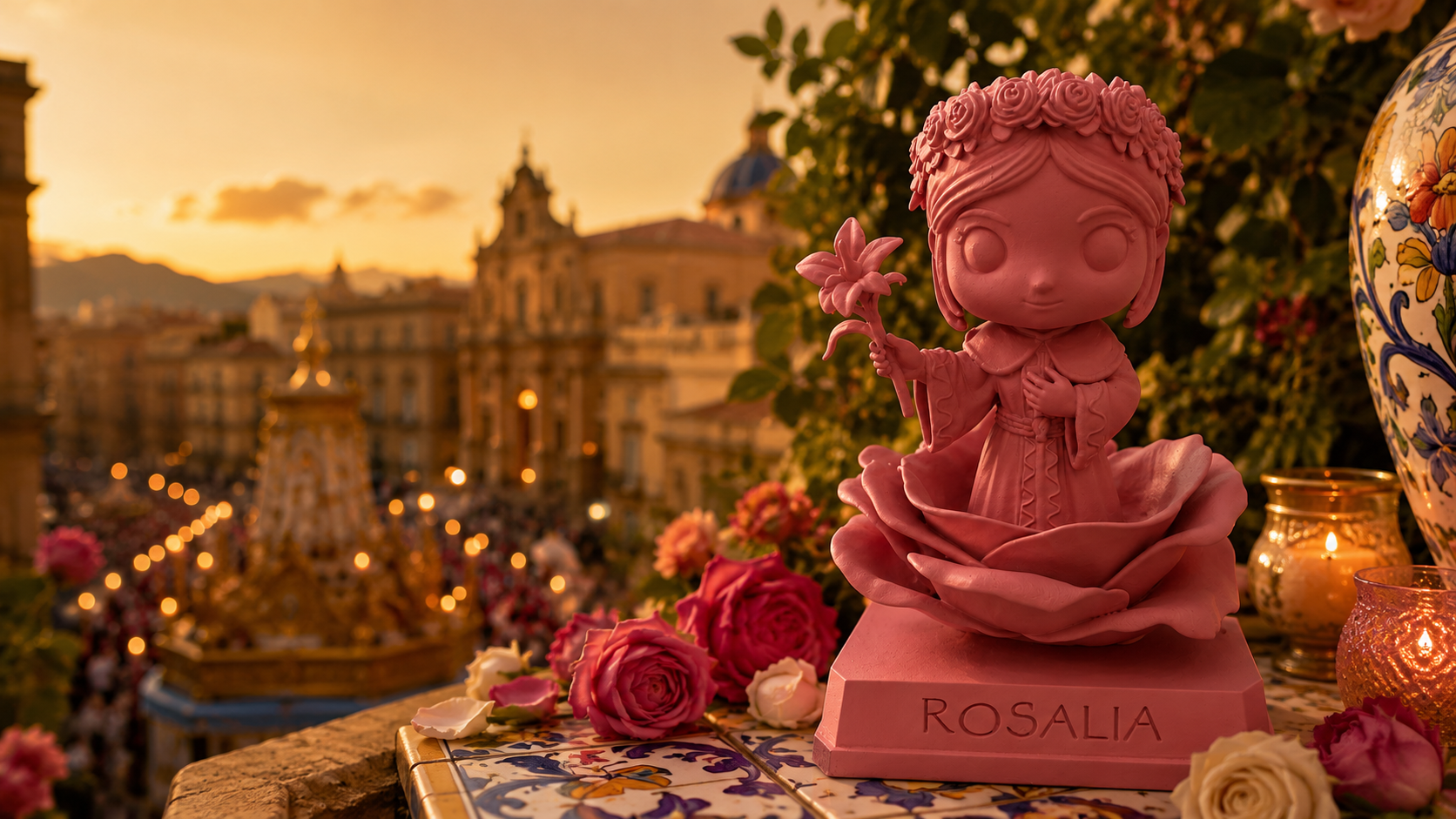
Our Saint Rosalia figurine is not intended to replace the traditional image of the Santuzza, but to offer a new interpretation: more playful, more contemporary, and closer to the world of design and visual storytelling. A small pink icon, delicate and recognizable, carrying roses, beauty, and Palermo's memory.
Alongside the figurine, in our shop we have chosen other objects that engage with this imagery: illustrated postcards, conceived as small fragments of Sicily to keep or give as gifts; rose liqueur, a sensory reference to the flower most closely associated with Rosalia's image; coffee with illustrations dedicated, transforming one of the rituals most beloved by Sicilians into a small storytelling object to take home, as well as a line of tea towels dedicated to Palermo
Because telling the story of Saint Rosalia means more than simply talking about a festival. It means talking about Palermo, its ability to transform history into beauty, pain into ritual, and memory into the future.
A contemporary Santuzza
The 402nd Feast arrives at a time when Palermo continues to redefine its identity: a Mediterranean city, a tourist city, a creative city, a fragile yet immensely powerful city. In this context, Saint Rosalia continues to serve as a symbolic compass.
Her image reminds us that icons are not static. They live because they are reinterpreted. They change form, color, and language. They can appear on a monumental float, in a postcard, in a collectible figurine, in a rose-scented liqueur, or in a story to share.
Rosalia is Palermo resisting, reinventing itself, dressing up for the festival, and turning once again toward the sea.
And perhaps this is the most beautiful meaning of the Feast: not merely celebrating what we have been, but imagining together what we can still become.
Long live Palermo. Long live Saint Rosalia.
Share:
Polyphemus, Circe, and Medusa: why the myths of the Odyssey still live on in Sicily